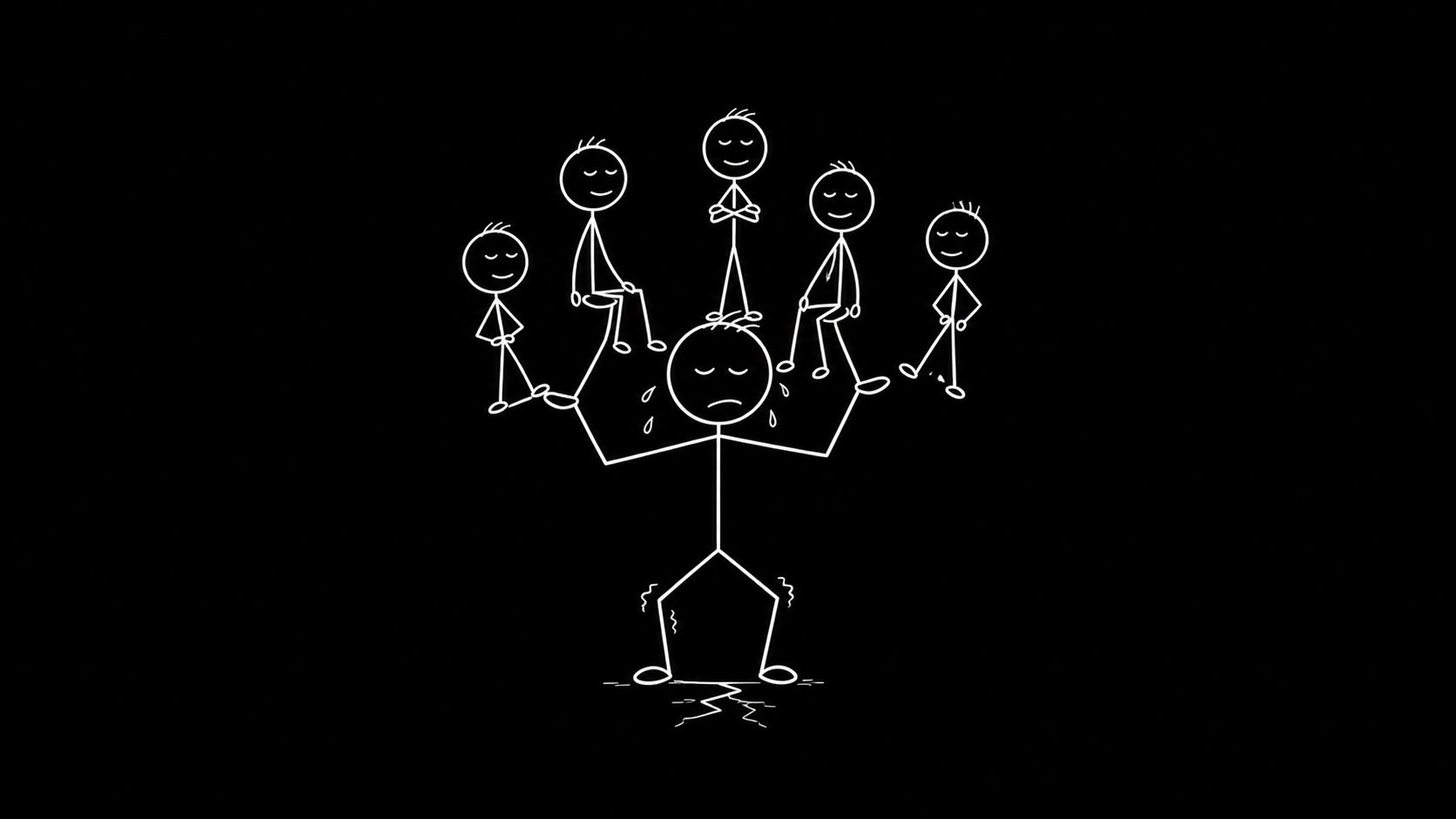
You are the one they call when things fall apart. When someone gets fired, when someone gets dumped, when someone needs to talk at midnight on a Tuesday. You pick up. You always pick up. You listen, you absorb, you reassure, you fix what you can, and you carry what you cannot.
And when you hang up the phone, nobody asks how you are doing.
Not because they are cruel. Not because they do not care. But because you have trained every person in your life to believe that you are fine. You have been so consistent in your strength, so reliable in your composure, that the people who love you have genuinely forgotten that you might need something too.
How the strong friend is made
Nobody decides to become the strong friend. It is not a personality trait. It is an adaptation.
Usually, it starts in childhood. Maybe you were the oldest sibling and had to take care of the younger ones. Maybe one of your parents was struggling and you learned early that your emotions were not the priority. Maybe your family praised you for being "mature," which was really just code for "easy to manage." You learned that love was conditional on usefulness. That the way to be valued was to be needed.
So you became indispensable. At home, at school, at work, in every friendship. You became the person people could count on. And each time someone leaned on you, it reinforced the belief: this is my role. This is what makes me worthy. Without this, I am nothing.
That is the foundation. And it is cracked from the start.
The emotional labor nobody sees
Being the strong friend is a full-time job with no salary, no vacation, and no acknowledgment. The labor is invisible because it does not look like work. It looks like listening. It looks like being available. It looks like having the right words at the right time.
But here is what it actually costs you: every conversation where you absorb someone else's pain requires you to temporarily suppress your own. Every time you hold space for another person, you contract your own space a little more. Every crisis you manage for someone else depletes the same reserves you need for yourself.
And unlike a job, you cannot clock out. There is no boundary between your life and your role. Because your role is your life. You do not know who you are without it.
Why nobody checks on you
This is the part that hurts the most, so I will say it plainly: people do not check on you because you have never given them a reason to worry.
You do not cry in front of others. You do not cancel plans when you are struggling. You do not send the honest text message at 11pm. You show up, you function, you perform wellness so convincingly that everyone around you believes it. And then you go home and sit in silence and wonder why you feel so alone in a life full of people who claim to love you.
The injustice is real. But the mechanism is partly yours. You built the wall. You maintained it. You punished yourself every time a crack appeared. And now you are angry that nobody can see past it, when seeing past it was never something you allowed.
This is not blame. This is clarity. Because you cannot change a pattern you do not see.
The fawn response disguised as kindness
There is a trauma response called "fawning." Most people know fight, flight, and freeze. Fawning is the fourth. It is the response that makes you manage other people's emotions to keep yourself safe. It looks like agreeableness. It looks like empathy. It looks like being "the nice one." But underneath, it is survival.
If you grew up in an environment where expressing your needs was punished, ignored, or met with someone else's bigger emotions, you learned to prioritize other people's comfort over your own. You learned that the safest position in any room is the one where everyone else is okay. If they are calm, you are safe. If they are happy, you are allowed to exist.
This is not generosity. It is hypervigilance dressed as warmth. And it is exhausting in a way that nobody who has not lived it can fully understand.
What happens when the strong friend breaks
The breaking does not look the way you might expect. The strong friend does not collapse in public. There is no dramatic scene. Instead, it looks like this:
You start avoiding phone calls. Not because you do not care, but because you have nothing left to give. You cancel plans and feel relieved instead of guilty, which alarms you because guilt used to be your default. You go through the motions at work, at home, in your relationships, but you are operating from a place so far below empty that the word "tired" does not even begin to describe it.
You might start resenting the people you love. This is the part that terrifies you, because resentment feels like failure. You chose to be there for them. Nobody forced you. So why does their name on your phone fill you with dread?
Because the contract was never fair. You gave without being asked if you had it to give. You said yes when your body was screaming no. And now the debt has come due, and there is no one on the other side of the counter.
The lie at the center of it all
The lie is this: if I stop being useful, I will be abandoned.
That is the core belief running the entire system. It is the belief that your value as a human being is tied to your function in other people's lives. That love is something you earn through service. That the moment you stop giving, people will leave.
And here is the painful truth: some of them will. Some of the people in your life are there because of what you provide, not who you are. Setting boundaries will reveal this. And losing those people will hurt. But keeping them was hurting you more, just in a way you had normalized.
The people who stay after you stop performing are the ones who actually love you. And you cannot find them until you let the others go.
What recovery looks like
Recovery from the strong friend pattern is not about becoming cold or selfish. It is about learning a skill you were never taught: receiving.
It means letting someone else hold the silence when you are struggling. It means sending the honest message instead of the reassuring one. It means allowing yourself to be seen in a state that is not put together, and trusting that the people who matter will not leave.
It means sitting with the discomfort of not being needed for five minutes, and discovering that you still exist. That you are still worthy of space and air and attention even when you are not solving someone else's crisis.
It means learning to check on yourself with the same urgency you check on everyone else.
A question worth asking
If you took away every role you play for other people, the listener, the fixer, the anchor, the therapist, the translator of other people's emotions, what is left?
If the answer scares you, that is the point. Because that empty space is not proof that you are nothing without your role. It is proof that you have been so consumed by the role that you forgot to build a relationship with yourself.
And that relationship is the only one that can actually save you.
If this felt personal, Not Giving a F*ck Anymore is about setting down the weight that was never yours to carry, and The Year I Stopped Pretending is about what happens when you finally let the mask fall.
Marieme Seck is the author of self-help audiobooks available on Spotify and 30+ platforms worldwide.