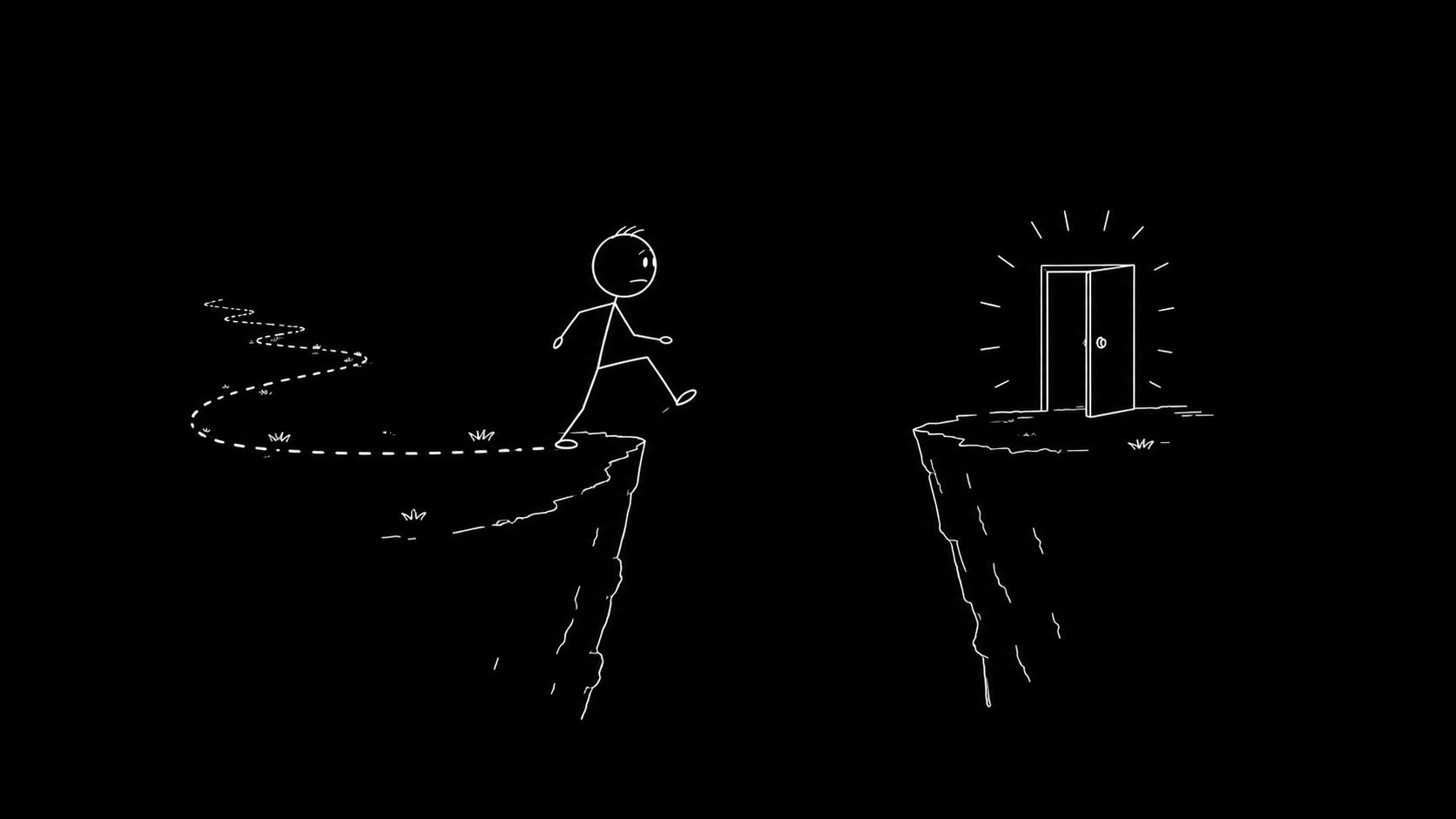
Somewhere around thirty, you did the math. You looked at where you are, looked at where you thought you would be, and the gap between the two made your stomach drop. Your friends are getting promoted, getting married, buying property, posting milestones. And you are sitting in your apartment wondering if anything you have built in the last decade actually belongs to you.
So you start considering something that terrifies you: what if I start over?
Not a vacation. Not a new hobby. A genuine reset. A new career. A new city. A new way of living that has nothing to do with the plan you inherited and everything to do with the person you are discovering you actually are.
And the moment you say it out loud, the world pushes back.
The myth of the linear life
We have been sold a model of life that looks like a straight line pointing upward. Each year should build on the last. Each job should pay more than the previous one. Each relationship should be more stable. Progress is measured by accumulation: more money, more status, more certainty.
By this logic, starting over is failure. It means the line went backward. It means something went wrong.
But that model was built for a world that no longer exists. It was built for a time when people chose one career at twenty-two and retired from it at sixty-five. When geographic stability was the norm. When questioning the plan was considered irresponsible.
The world you actually live in is different. Careers change. Industries collapse and emerge. People live longer, work longer, and have the option of multiple chapters in a single life. The linear model does not account for any of this. And clinging to it means judging yourself by standards that expired before you were born.
Why your 30s are actually the ideal time to start over
Your twenties gave you something invaluable, even if it does not feel like it right now. They gave you data. You spent a decade testing assumptions, and now you know which ones were wrong. You know what kind of work drains you. You know what kind of relationships cost more than they give. You know what you can tolerate and what is slowly killing you.
That knowledge is not nothing. It is the foundation for every good decision you are about to make.
In your twenties, you were guessing. In your thirties, you have evidence. And evidence-based reinvention is infinitely more powerful than the blind optimism that carried you through your early career. You are not starting from zero. You are starting from experience. And that is a different thing entirely.
The grief nobody warns you about
Here is the part that catches people off guard: starting over involves grief. Real grief. Not just for the life you are leaving, but for the version of yourself who tried so hard to make it work.
You grieve the years you spent in a career that was never right. You grieve the relationship you stayed in because you thought leaving meant failing. You grieve the version of your twenties that you spent performing instead of exploring. You grieve the life your parents imagined for you that you can no longer pretend to want.
This grief is not a sign that you are making the wrong decision. It is a natural response to letting go of something you invested in deeply. You are allowed to be sad about something that is also necessary. Those two things can be true at the same time.
The people who will not understand
When you announce that you are changing direction, certain people in your life will react poorly. Not all of them. But enough of them to make you question yourself.
Your parents might panic, because your stability was their reassurance. Your friends might feel threatened, because your change forces them to look at their own stagnation. Your partner might resist, because the person they signed up for is evolving into someone they did not plan on.
This is not cruelty on their part. It is fear. Your decision to change disrupts the ecosystem they were comfortable in. And most people would rather you stay miserable in a way they understand than become happy in a way they cannot predict.
You will need to accept that some relationships will not survive your reinvention. Not because those people are bad, but because some connections are built on a version of you that no longer exists. Letting them go is part of the process.
The financial fear is real, and you should plan for it
I am not going to pretend that starting over has no practical cost. It does. Changing careers often means a temporary drop in income. Moving cities means new expenses. Leaving a stable situation means losing a safety net you may have spent years building.
The answer is not to ignore this. The answer is to plan for it without letting it paralyze you. The people who successfully start over do not leap blindly. They build a bridge. They save money before they quit. They develop new skills while still employed. They test the new direction on weekends before committing to it full-time.
The fear of financial instability is valid. But do not confuse it with a reason to stay forever. A life you can afford but cannot stand is not stability. It is a different kind of poverty.
"But what will people think?"
This question has stopped more reinventions than financial risk ever could. The fear of being perceived, of being judged, of having to explain yourself to people whose opinions should not matter but somehow do.
Here is what people will think: some will admire you quietly and never say it. Some will judge you openly and forget about it within weeks. Some will project their own regrets onto your decision. None of their reactions change whether the decision is right for you.
The person whose opinion matters most in this equation is the one you will be five years from now. Imagine them looking back at this exact moment. Are they grateful you stayed where you were? Or are they grateful you moved?
You already know the answer.
What starting over actually looks like
In the movies, starting over is a montage. New city, new wardrobe, new life in three minutes set to an uplifting soundtrack.
In reality, it looks like sitting in a quiet room asking yourself what you actually want and not knowing the answer. It looks like filling out applications for things that excite and terrify you in equal measure. It looks like being the oldest person in a beginner's class and staying anyway. It looks like going to bed uncertain and waking up uncertain and doing the work in between.
It looks messy. It looks slow. It looks like doubt with moments of clarity, not the other way around.
But here is what nobody tells you: the discomfort of starting over is temporary. The discomfort of staying in the wrong life is permanent. It just becomes so familiar that you mistake it for normal.
The version of you on the other side
There is a version of you that already exists on the other side of this decision. They are not perfect. They have not figured everything out. But they are doing something that the current version of you cannot: they are living a life they chose.
Not a life they inherited. Not a life they stumbled into. Not a life they maintain out of fear. A life they looked at with clear eyes and said: this one. This is mine.
Getting there requires the one thing that no productivity hack, no self-help framework, no motivational quote can replace: the willingness to be a beginner again. To be bad at something new. To tolerate the awkwardness of growth after years of coasting on competence.
That willingness is not weakness. It is the bravest thing a person can do in a world that rewards staying safe.
You are not too late
You are not too old. You are not too behind. You have not missed your window. The window is open right now, and it will stay open for as long as you are willing to walk through it.
The people who actually miss their chance are not the ones who start late. They are the ones who never start at all. The ones who spend another decade maintaining a life they do not recognize, waiting for a certainty that never comes, and calling it responsibility.
Starting over at thirty is not a failure. It might be the first truly honest decision you have ever made.
If you are in that in-between space right now, The Year I Stopped Pretending is about the moment you stop living for the approval of others and start building something real. And Not Giving a F*ck Anymore is the book that started this entire conversation.
Marieme Seck is the author of self-help audiobooks available on Spotify and 30+ platforms worldwide.