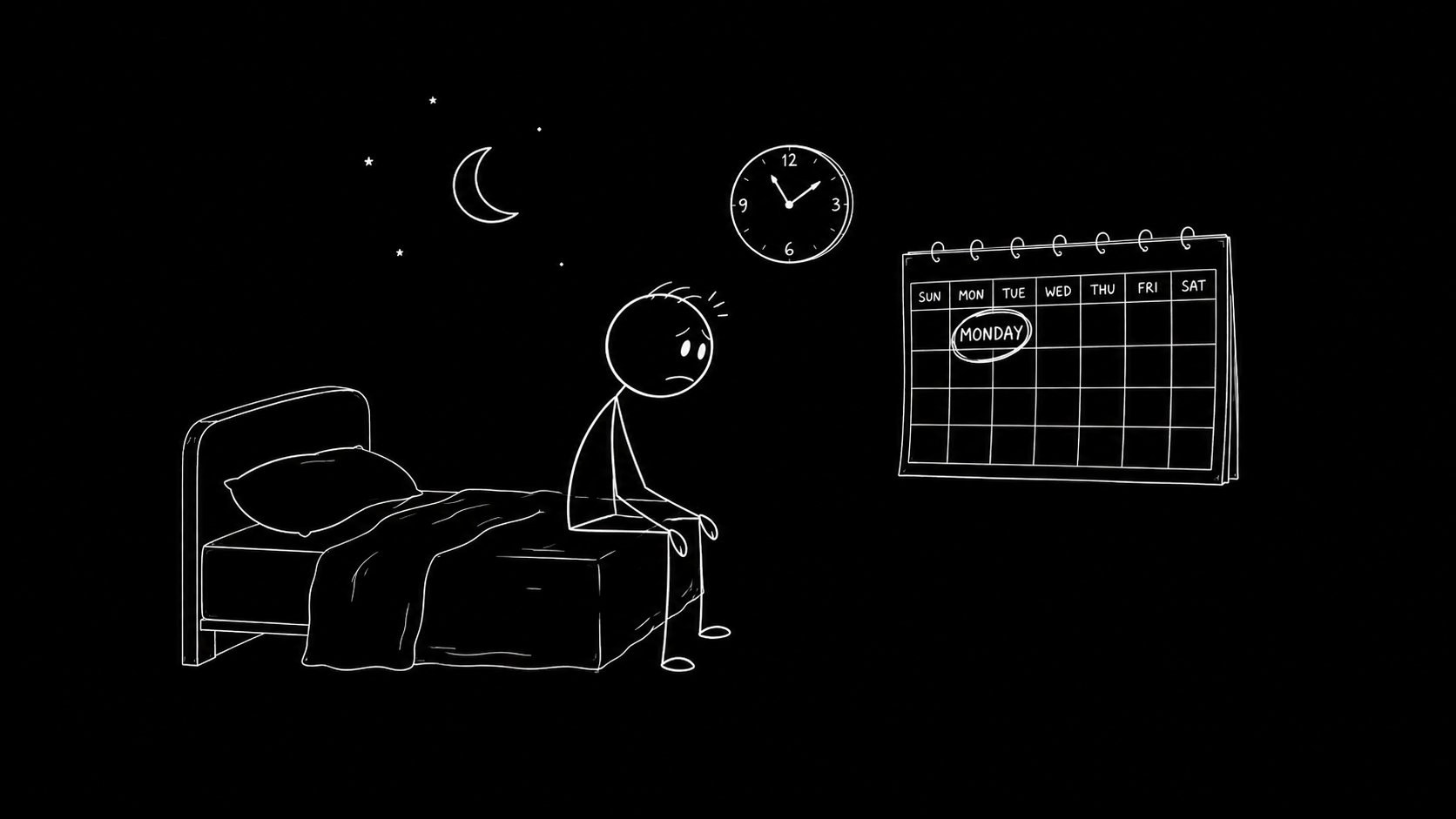
It usually starts around 5pm on Sunday. The afternoon light shifts, the weekend starts to feel like it is slipping through your fingers, and a quiet dread settles into your chest. By the time you are lying in bed, your mind is already at work on Monday morning, running through the meetings, the emails, the things you did not finish. You are not even there yet, and you already feel exhausted.
This has a name now. The Sunday scaries. And while the internet treats it as a relatable joke, it is worth taking seriously, because it is one of the most honest signals your body sends you all week.
What the Sunday scaries actually are
At the simplest level, Sunday night anxiety is anticipatory dread. Your brain is previewing the week ahead and bracing for it. This is normal to a degree. The transition from rest to responsibility is real, and almost everyone feels some version of it.
But there is a difference between a mild reluctance to leave the weekend behind and a genuine sense of dread that ruins your Sunday evening every single week. The first is human. The second is information. If you spend one full day of every weekend anxious about the other five, your body is trying to tell you something that your mind keeps overriding.
The question underneath the dread
Here is the uncomfortable part. The Sunday scaries are often not about Monday at all. They are about the life Monday represents. If you dread the week ahead, the real question is not how to manage the anxiety. It is what, specifically, are you dreading.
Sometimes it is one toxic relationship at work. Sometimes it is a workload that has quietly become unsustainable. Sometimes it is the slow realization that you have built a life that looks fine on paper and feels wrong in your body. The dread is not the problem. The dread is the symptom. And treating the symptom, with Sunday night routines and breathing exercises, while ignoring what it points to, is how people stay stuck for years.
When it is manageable and when it is a signal
Ask yourself a simple question: is this a Sunday problem or a life problem? If you generally like your work and your week, and the Sunday dread is just the friction of transitioning out of rest, then yes, the usual advice helps. Prepare on Friday instead of Sunday. Protect your Sunday evening. Build something to look forward to on Monday.
But if the dread is constant, if it has lasted months or years, if Sunday night feels like the slow approach of something you cannot escape, then no routine will fix it. That is not anxiety to be managed. That is a life asking to be changed.
What to do with the information
Start by naming the specific thing. Not "I hate Mondays" but "I dread the Monday status meeting because my manager humiliates me in front of the team." Specificity turns a vague cloud of dread into a problem you can actually solve. Vague dread is paralyzing. Specific problems have options.
Then ask whether the thing is changeable. Some sources of Sunday dread can be addressed directly: a conversation, a boundary, a shift in how you work. Others are structural and point to a bigger decision. Either way, the dread has done its job. It got your attention. The worst thing you can do is keep numbing it every Sunday and calling that coping.
If your Sunday dread comes from a slow exhaustion you cannot explain, The Silent Burnout and Nothing Feels Good Anymore go deeper into what happens when you ignore the signal too long.
Marieme Seck is the author of self-help audiobooks available on Spotify and 30+ platforms worldwide.