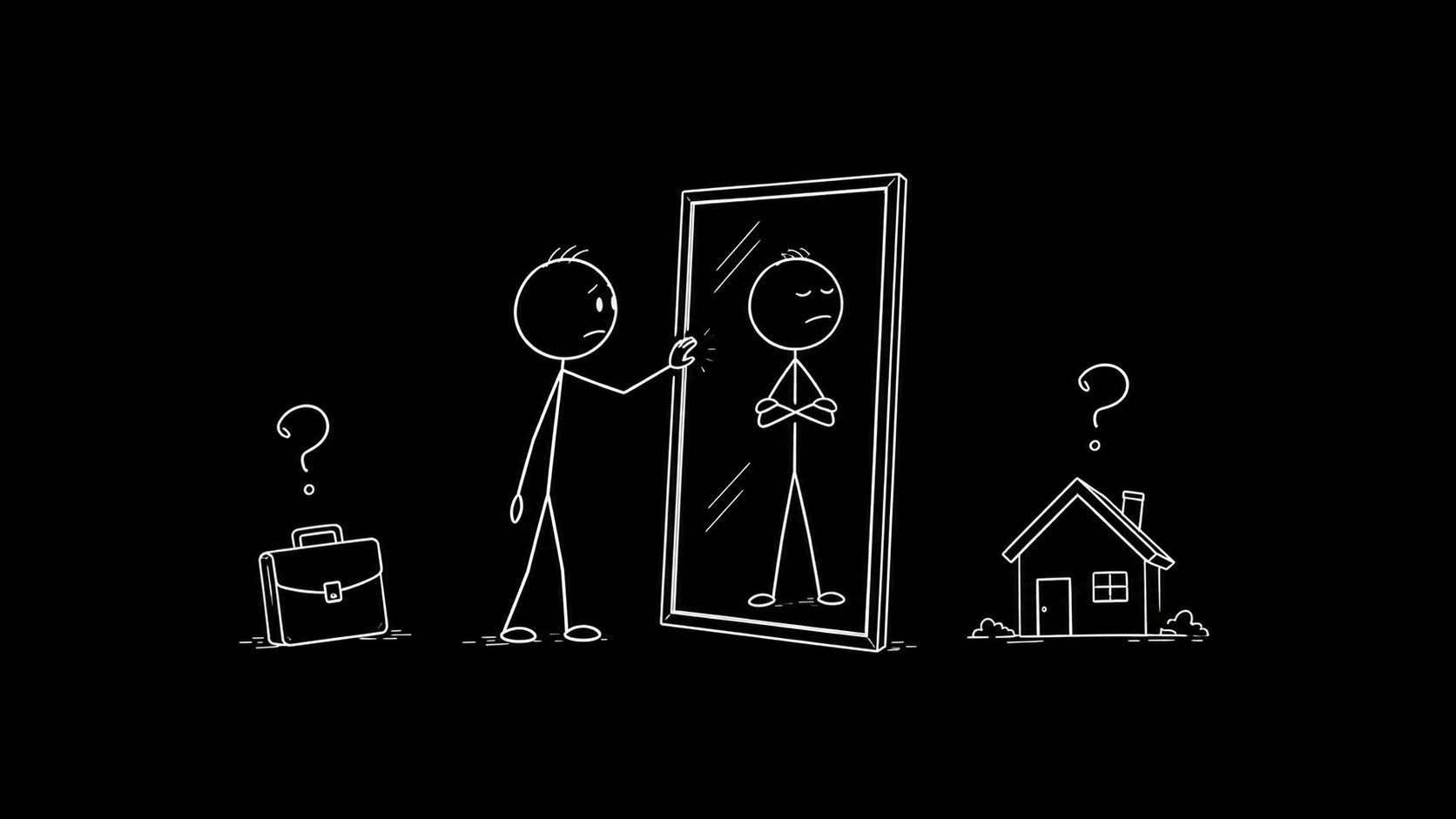
You have the apartment. You have the job. You have the relationship, or at least the appearance of stability. You have built something that, from the outside, looks exactly like a life. And yet there is a moment, maybe at a dinner with friends, maybe in the car on the way home from work, maybe lying next to someone you love, where a thought crosses your mind so clearly it startles you:
This is not my life.
Not in a dramatic way. Not in a movie-scene way. More like a quiet observation. A fog that has been there for months, maybe years, that you have learned to function inside of. You do not hate your life. You just do not recognize it. You look at your calendar, your routines, your circle, and you cannot trace any of it back to a decision you made freely. It all just happened. And now you are here.
The script nobody handed you (but you followed anyway)
There is a version of your life that was written before you were born. Go to school. Get good grades. Get into a good university. Get a respectable job. Find a partner. Settle down. Be stable. Be grateful. Do not ask questions that make people uncomfortable.
Most people follow this script without ever consciously agreeing to it. Not because they are weak or unimaginative, but because the script is invisible. It does not announce itself. It shows up as expectations from parents, as peer pressure disguised as advice, as cultural norms so deeply embedded that questioning them feels like questioning gravity.
The problem is not that the script is bad. For some people, it works. The problem is that it is one script for millions of different people. And when your inner architecture does not match the blueprint you were handed, you end up building a life that looks right from outside but feels hollow from inside.
Why this hits hardest between 27 and 38
There is a reason this feeling tends to arrive in your late twenties or thirties. Before that, you are still building. You are too busy executing the plan to question whether the plan was yours. The momentum of school, early career, and social milestones carries you forward without much reflection.
Then something shifts. You finish building. You arrive. And the arrival feels nothing like you expected. You thought you would feel settled, proud, at home. Instead you feel a strange emptiness. You thought the destination would explain the journey, and it does not.
This is also the age when the gap between your public self and your private self becomes impossible to ignore. You have been performing a version of yourself for so long that you have lost track of who you are without the performance. You are the competent one, the reliable one, the one who has it together. And underneath all of that, there is a person you have not spoken to in years.
It is not depression (though it can look like it)
This feeling is often mistaken for depression. And in some cases, there is overlap. But there is a specific quality to this experience that is different from clinical depression. It is not that you cannot feel. It is that what you feel does not match what you are living.
You can still laugh. You can still enjoy a good meal. You can still have a decent weekend. But underneath it all, there is a disconnect. A gap between the surface and the foundation. Like living in a beautifully furnished house and knowing, somewhere in your body, that it was built on someone else's land.
Therapists sometimes call this "existential discontent." It is not a disorder. It is a signal. Your psyche is telling you that the life you are living is not aligned with the person you actually are. And the longer you ignore the signal, the louder it gets.
The roles that replace your identity
One of the ways people lose themselves is by becoming their roles. You become "the mother." You become "the provider." You become "the responsible one." You become "the person who never complains." And slowly, the role eats the person underneath.
This is especially common for people who grew up having to be useful to survive. If your value as a child was tied to being good, being quiet, being helpful, being mature beyond your age, then you learned early that who you are matters less than what you do for others. You carried that into adulthood. You became indispensable at work, irreplaceable in your friendships, the one everyone leans on. And somewhere in the middle of all that service, you disappeared.
The cruelest part is that people praise you for it. They tell you how strong you are, how generous, how selfless. And every compliment lands like a small burial. Because they are not praising you. They are praising the mask. And nobody is asking what is underneath.
What "authenticity" actually requires
The internet has turned authenticity into a brand. "Be yourself" is printed on mugs and sewn into throw pillows. But real authenticity is not comfortable. It is not a vibe. It is a confrontation.
Being authentic means admitting that some of the things you have built do not serve you. It means looking at relationships you have maintained for years and acknowledging that you stayed out of obligation, not love. It means admitting that the career you worked so hard for does not excite you and never really did. It means telling people things they do not want to hear and being willing to lose their approval.
That is why most people avoid it. Not because they do not know who they are, but because the cost of admitting it feels too high. If I say this is not my life, then what? If I walk away from the script, what do I walk toward? The uncertainty is paralyzing.
Why the fear of wasting time keeps you stuck
There is a specific fear that traps people who feel this disconnect. It is the fear of having wasted time. If I admit that this life is not mine, then what about the last ten years? What about the degree I finished? The promotion I chased? The relationship I stayed in?
This is sunk cost applied to identity. You stay in a life you do not recognize because leaving it means confronting everything you invested in it. And nobody wants to sit with that grief. So you keep going. You redecorate the house instead of questioning whether you should be living in it at all.
But here is the thing nobody tells you: the time is already spent. Whether you stay or leave, those years are gone. The only question that matters is what you do with the years you still have. And every day you spend performing a life that is not yours is another day added to the total you will eventually grieve.
The moment before everything changes
There is a pattern in the stories of people who eventually reclaim their lives. Before the change, there is always a period of unbearable clarity. A moment where the fog lifts just enough for you to see the full picture, and the full picture is devastating. You see how long you have been pretending. You see how much energy it costs. You see how far you are from the person you could have been.
This moment is not the problem. It is the beginning of the solution. Because you cannot change a life you are still pretending to enjoy. The clarity hurts, but it is also the first honest thing that has happened to you in years.
You do not need to blow up your life. You do not need to quit your job tomorrow or end your relationship tonight. But you need to stop lying to yourself about what you feel. That is the minimum. That is where it starts.
Small reclamations
Reclaiming your life does not usually happen in a single dramatic gesture. It happens in small, almost invisible decisions.
It looks like saying no to a dinner you never wanted to attend, and not explaining why. It looks like spending a Sunday doing something you actually enjoy instead of something that looks good on social media. It looks like admitting to one person, just one, that you are not as fine as you seem.
It looks like pausing before you say yes. Noticing the automatic responses. Catching yourself performing. And in that pause, asking: is this what I want, or is this what I think I should want?
That pause is everything. It is the space where your real self starts to breathe again.
You are not broken for feeling this
If you are reading this and something in your chest is tight, that is not a sign that something is wrong with you. It is a sign that something in you is still alive. Still paying attention. Still waiting for you to listen.
The people who feel nothing about their disconnection are the ones to worry about. The fact that you feel it means you have not given up. It means there is still a version of your life that belongs to you, waiting on the other side of the performance.
You do not have to find it today. But you do have to stop pretending it is not there.
If this resonated, The Year I Stopped Pretending goes deeper into the architecture of the false self and what it takes to dismantle it, one honest decision at a time.
Marieme Seck is the author of Not Giving a F*ck Anymore, The Silent Burnout, and other self-help audiobooks available on Spotify and 30+ platforms.